The Trial Chicken Run

The Trial Chicken Run

This fall my cousins, the Karr family, and I partnered in our first attempt at raising meat chickens on the land.

Recognizing that chickens’ presence on our grazing lands would be ecologically beneficial as well as filling an economic niche, we decided that adding chickens would be a sooner or later project, so we chose sooner.

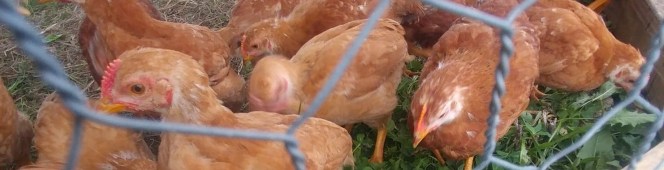
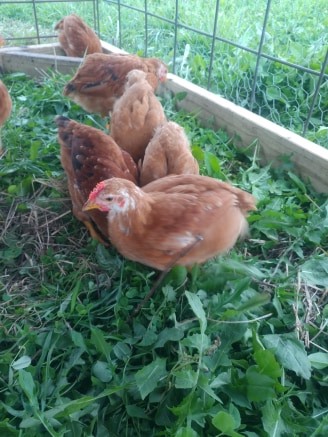
In fact, instead of waiting until spring, we started a hatch in early September, so that we could accelerate our learning curve (and experiment). We ordered 50 red ranger broiler chicks; 48 of them were moved to pasture with a partially enclosed hut made of cattle panels and tarp. Their slide-able hut was moved as often as possible, or they were allowed to walk around within an electric chicken fence.

We threw a number of experimental factors into the mix:

  1. Early, September frost and unexpected cold right after we put the chicks on the ground.
  2. Could they grow muscle on farm-grown ground corn alone? Not so well.
  3. Would they eat flax or flax seed meal, thus enhancing their omega-6 profile? Flax didn’t excite them.
  4. What about weevil-eaten gamebird feed? They loved it.

All along the way, the chickens preferred to peck the ground versus empty the feeder. Red rangers are bred to be more like their jungle-fowl predecessors than their confinement barn contemporaries. Our rangers ate every kind of leaf, insect, and seed before turning to the feed provided.
87359745_204541944284842_3430234308793597952_n

Cold weather and dietary mismatch kept our birds from filling out on the usual schedule. We postponed harvesting the chickens by about two months.

When it came for butchering, we gathered the chickens in the dark (much less stressful) and I took them to a USDA-inspected poultry facility for processing, so that the chickens can be sold anywhere (as far as I’m aware).

There, the carcasses were air-chilled, as opposed to the typical ice water bath. This has two big advantages: one, it’s assumed that any organisms on one chicken body are not as likely to be passed to the rest, as compared to one big bath; two, the packaged chicken is not full of added water, so the customer is only paying for the natural weight of meat and bone.

Our packaged and frozen chickens weigh between 4.5 and 6.5 lbs. They are available for purchase in Monroe City for about $14 apiece.

How’s the eating?

Good. And different. That’s what we planned.


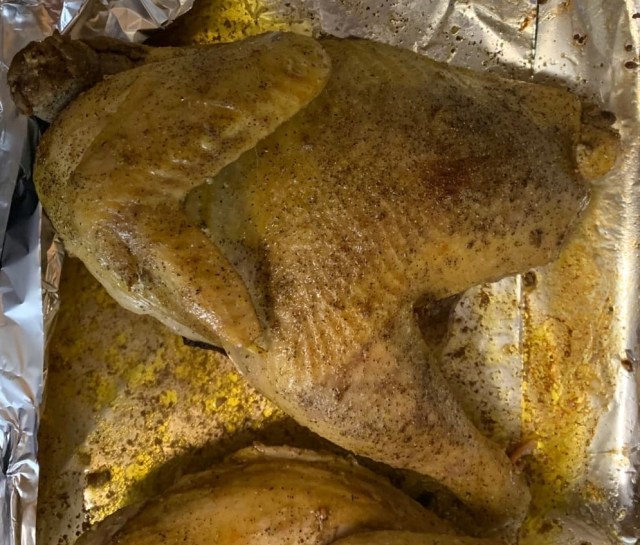
The extra age on these birds means they have dark leg meat, which has it’s own profile of flavors. Different is what we were counting on, though we didn’t plan for over-mature. Going in, we expected that our chickens would stand apart in flavor and richness.

Most of us have no idea today what a chicken tastes like without being raised on processed feed. This winter, we are getting an idea of that, but I think we have plenty of potential for making better tasting birds. The ground will be much greener when our future broilers hit the ground. 87836121_133643504631443_3141137212536520704_n
Part of me wonders if we should keep over-maturing these birds–flavor takes time to establish in meat–but we shall see.

We learned that we won’t be trying to raise any more chicks in October. We’ll be re-aiming at feed sources.

I plan to trail chickens behind the sheep paddocks by about three days difference as they cross the pastures.


-CY
 

“The New Economy” and the “Law of Attraction”

“The New Economy” and the “Law of Attraction”

Uber, Seamless, InstaCart, Airbnb. They’re all about maximization. We can call some of these class of businesses “the sharing economy,” but they have more to do with filling gaps than they do sharing.

“Filling the gaps” is an essential method of Life. At the microscopic level, living organisms are teeming across nearly everything. And life brings more life.

This isn’t merely a program for survival. It’s a program for abundance.

The New Economy, whether it’s sharing, or gap-filling, or “anti-rivalrous,” is a step toward abundance economics.

These thoughts come on the heels of an exchange with Jason Mauck. I thought of Jason as I was  writing my previous post. I was pretty well singing his song. I think he was pleased to read it.

mauck

‘Nature abhors a vacuum,’ it is said. Yet contemporary agriculture methods put a lot of effort into killing things.

That force of nature opposing the vacuum is life. We should embrace the abundance economy of nature, and fill the gaps (like Jason is doing, shown above).


The average price of an idea is zero.

Ideas are too abundant, and their applications are either often specialized beyond the idea originator’s power, or so ubiquitously useful that charging for them is irrelevant.

In either case, the average idea originator stands to gain much more from the fruition of his freely given idea than one could ever expect to charge for a mere idea, or bit of knowledge.

This is the case with regenerative agriculture and “open sourcing ideas.” I stand to gain quite a lot from a world full of people who are better nourished and closer to the land. Much more than any fortune I could expect from raising high-margin lamb for the rest of my life.

Humanity working together, in free trade, is a lever.

I submit that we need more than regenerative agriculture, however. We need sound money–regenerative economics broadly–as a platform. We need regenerative, integrative education to grow the minds who will inherit this earth.


“Open source” is a program for abundance because of its magnetism.

I’m not trying to bring about some unpaid open-source dogma here. I’m just trying to say that breaking down the walls between idea hives has more benefits than silo-ing and continuing to play the scarcity-survival game.

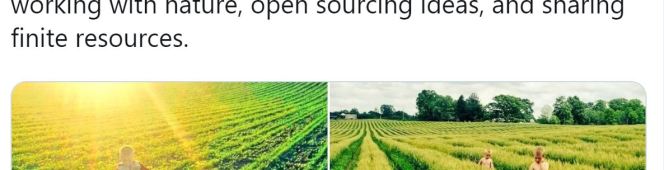
When Jason Mauck began tweeting his wild ideas, others on Twitter started shedding their protective layers (yes, there’s plenty of flack too). People started dreaming out digitally. More importantly, an idea was unleashed: Just maximize the space and resources you have, in every way, all the time! 

There’s a finer subtext to many of the thoughts Jason shares: Pay more attention. Nature is ready to work with you. She’s ready to fill gaps. Work with that.

As these things go, ideas trickle back to Jason, which means they trickle back to the rest of us.

Someone said to me recently, “Electricity is always there. You just can’t see it until it moves.”  So, our energy does need to move–between ourselves–or dissipate. By opening up, to possibility and with positivity, we can build regenerative communication and community.

That’s weird enough for this Sunday night.


Kind regards,

Cary Yates

Grazing animals made the Earth we know.

Grazing animals made the Earth we know.

Did you know that?

I’m sure you know that massive herds of bison once traversed much of North America. You probably know that caribou still migrate over around the top of the world, feeding on next-to-nothing. Wild sheep still wander through Mongolia. Multiple species of grazing animals move through the Serengeti together.

They are essential to our lives on Earth, not harmful.

For much longer than humans have been relevant as apex predators, such animals have roamed and evolved—evolved with the lands and plants beneath them.

When tall grasses came onto the stage of life, around 500 millions years ago, they had a counter-intuitive need, in order to not only self-replicate, but to keep on living.

The tall grasses needed to be eaten and trampled. Occasionally.

That is just what large herds of grazers did. As well, the animals spread their saliva and waste behind them, re-inoculating the land with their own special gut flora every time they visited.

These enormous herds did not visit but once or twice a year—perhaps not every year—but when they did, they mashed down much of the plant matter they did not eat.

Thus, they exposed the bases of perennial grass plants to sunlight, allowing them to keep growing. And dead, oxidized plant matter was trampled back to the ground, where it became habitat for a new set of (tiny) creatures before decaying fully.

These great animals—bison, buffalo, zebra, horse, caribou, sheep, elephant, mammoth, cattle, and many more—have not only been essential sources of human sustenance, but the gears of a gigantic photosynthetic engine powering the planet’s oxygen supply and carbon cycle. They are essential to our lives on Earth, not harmful.

How we interact with and manage wild herds and livestock is the determining factor in the preservation AND ENHANCEMENT of our planet. Fertile soil and functioning water cycles require better grazing management (as well as less crop farming).IMG_1322

It’s with these thoughts in mind that I’m pushing to add goats to our operation. And I’m asking for your help so that I might also add cattle this year, while simultaneously purchasing bees and growing mushrooms.

One little farm a time, focusing on farming in nature’s image, can bring us the environmental resilience and quality of life we seek.


Promote-A-Goat Update 2

Not everyone is up to speed on the very desirable nature of grazing animals. It is true that our dominant methods of raising main livestock species are disconnected from the land in ways that decrease planetary and human health. And it’s on these grounds that many advocate for the abolition of meat eating. If you’ haven’t seen it yet, you will. I have been following the effort for more than ten years (beginning with groups that thinly disguise themselves as animal advocates.

One of the latest moves contributing to limiting food independence and meat production was a Facebook policy change banning the advertisement or sale of any live animal on its platform. Facebook’s change was devastating for a number of people using the platform to transact thousands of dollars worth of chicks, dogs, sheep, and many other animals.

I don’t mention this event to pry into Facebook’s motivations. I’m interested in the results.

The internet has become the central pillar of society. Facebook plays no small part in that. As we look toward forming regenerative systems, I’m certain that a main pillar is getting face to face again. Regenerative society means up-cycling the energy between us, and reducing the exposure to energy being whisked away (such as by third-party whim).

What does this have to do with Promote-A-Goat?

After submitting an advertisement to Facebook yesterday, I soon realized that my ad was not obviously (enough) composed to communicate that I’m selling goat and lamb meat. 20 hours later, that ad is still pending approval, and the new ad I submitted one hour ago was accepted 30 minutes later.

Why an ad?

Though I truly want to market healthy meat as close to home as possible, I accept that the most ready markets for lamb and goat are more than an hour away.  And the first task on my plate, in the process of direct marketing, is selling to those who already want the product.

Again, why bring up Facebook and the backstage stuff?

I’m trying to make this a regenerative process, wherein anyone can learn what it’s going to take to regenerate, whether as a farmer or regenerative consumer.

So, watch where your energy goes. See where it’s wasted. See where it swells.

I know my energy is not swelling on Facebook, so it’s time to think more about next steps.


Best regards,

Cary


Next update: To the marginal meat buyer

Promote-A-Goat: Sponsor Regenerative Development

I have spent much of the last year pondering ways to build regenerative models of farm & community—structures and systems that bring eaters and farmers closer together, bringing both parties closer to the land, strengthening both, preserving and building energy in economies.

At some point, one must step out and try something… Continue reading